

Title: Enhancing Efficiency and Safety: The Role of Self-Acting Reducing Valves

Self-acting reducing valves play a critical role in various industrial and commercial applications, where precise control of pressure is essential for efficiency, safety, and performance. These valves, categorized into direct-acting and relay-operated types, are instrumental in regulating pressure for steam, compressed air, liquids, and gases, ensuring optimal conditions at the point of use. Let's delve into the functionality and applications of self-acting reducing valves and their significance in diverse systems.

Direct-Acting Pressure Reducing Valves
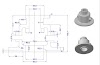
Direct-acting pressure reducing valves, such as the one depicted in Figure 1, are designed for point-of-use installations, where precise pressure control is required. These valves are commonly used for steam, compressed air, and gas applications. Here's how they work:
- Start-up: The valve remains closed initially, with the upstream pressure holding the valve head against the seat, aided by a return spring.
- Pressure Adjustment: A handwheel allows for the adjustment of downstream pressure. Rotating the handwheel compresses the control spring and extends the bellows, opening the main valve.
- Modulation and Control: As downstream pressure increases, it acts through the bellows to counteract the spring force, modulating the main valve to maintain a constant downstream pressure.
Materials used for construction, including phosphor bronze and stainless steel, ensure durability and compatibility with different media.


Balanced Piston Design for Liquids
Figure 2 illustrates a direct-acting reducing valve designed specifically for liquids, featuring a balanced piston design for accurate pressure control under stable load conditions. Installed in horizontal pipelines, these valves find applications in various industries, including laundry equipment and injection molding machines.
Applications and Benefits
Self-acting reducing valves serve diverse purposes across different systems:
- Water Systems: In water systems, pressure reduction aids in efficient piping design, reduces noise from high velocity, and prevents issues like high-pressure discharge at taps and climbing overnight pressures.
- Steam Distribution: Effective steam distribution relies on maintaining optimal pressure levels for efficiency and safety. Self-acting reducing valves ensure precise pressure control at the point of use, enhancing heat transfer and reducing water waste.
Conclusion
Self-acting reducing valves are indispensable components in industrial and commercial systems, providing precise pressure control for steam, compressed air, liquids, and gases. Their ability to regulate pressure ensures efficient operation, enhances safety, and prolongs the lifespan of equipment. Whether in water systems, steam distribution networks, or other applications, self-acting reducing valves play a vital role in optimizing performance and achieving operational excellence.




0 Comments